 SEAFDEC/AQD Southeast Asian Fisheries Development Center | Aquaculture Department
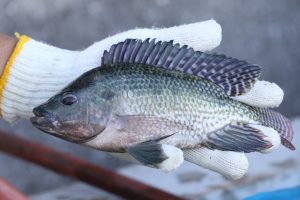 Why TILAPIA?
Tilapia is known as the “aquatic chicken.” It has become a global staple fish and protein source because it grows fast and breeds easily in captivity. An easy fish to culture, it is tolerant to a wide range of salinity and temperature levels. Moreover, farming tilapia requires minimal inputs.
How to breed and culture TILAPIA?
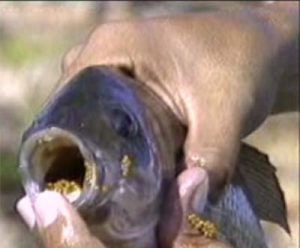
Hatchery in netcages
- Install 3 x 10 x 0.75 m fine-meshed netcages in ponds or 3 x 10 x 1.5 m fine-meshed netcages in lakes
- Stock four (3 females and 1 male) or five (4 females and 1 male) tilapia breeders (3-4 month old, minimum 100 g) per square meter
- Feed breeders at 3% of total biomass with tilapia feeds containing 40% protein
- Check for the presence of fry three weeks after stocking the breeders
- Collect fry and transfer to nursery netcages
- Place breeders in separate holding facilities and continue feeding them high-protein tilapia feeds for the next breeding cycle
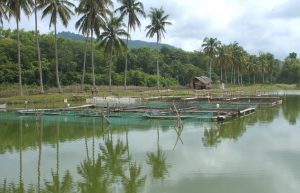
Nursery in netcages
- Stock 800-1,000 fry/m2 in netcages of appropriate mesh size
- Feed fry with supplemental feeds to avoid or minimize cannibalism
- Sort fry after two weeks
- Re-stock fingerlings according to size in separate netcages
- Transfer fingerlings to grow-out enclosures when total length is 37 mm (size 17) to 46 mm (size 14)
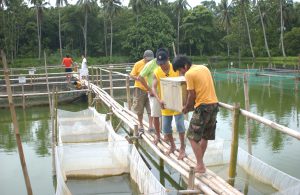 Grow-out in ponds
- Prepare the pond by sun drying the pond bottom and applying lime to stabilize soil and water pH. Lime is unnecessary when soil pH is above 7.5 and the alkalinity of the pond water is above 50 mg/liter of CaCO3
- Stock 1-2 fingerlings/m2 for extensive systems, 3-4 fingerlings/m2 for semi-intensive systems, and 5-10 fingerlings/m2 for intensive systems
- Feed fingerlings with tilapia feeds daily at 2-3% of the total fish biomass in semi-intensive systems and at 3-5% of the total fish biomass in intensive systems
- Intensive systems require good water management (water change as needed) apart from additional provisions like paddlewheel aerators
- Harvest fish when they reach the market size of 150-300 g (4-6 months)
Is TILAPIA seed production profitable?
Technical information for a small-scale netcage-based hatchery
| No. of broodstock (F=1,600; M=400) | 2,000 |
| Female broodstock that produces fry per cycle (%) | 80 |
| Fry production per female broodstock (pcs) | 200 |
| Production per cycle (pcs) | 256,000 |
| Number of cycles per month, 36 days | 2 |
| Productive months per year | 10 |
| Production per month (pcs) | 358,400 |
| Recovery after one month (%) | 70 |
| Production per year (pcs) | 3,584,000 |
| Farm gate fry selling price, size 22 (PhP/pc) | 0.45 |
| Gross sales | 1,612,800 |
Costs-and-returns (per year) (as of 2016)
| Total variable cost (PhP) | 436,000 |
| Total fixed cost (PhP) | 450,000 |
| Net income per year (PhP) | 726,800 |
| Internal rate of return (%) | 146 |
| Return-on-investment (%) | 163 |
| Payback period (years) | 0.48 |
Is TILAPIA farming profitable?
Technical information for a 5-hectare tilapia grow-out pond
| Project duration (years) | 5 |
| Area (ha) | 5 |
| Stocking density (per m2) | 7 |
| Total stocks per crop | 350,000 |
| Croppings per year | 2 |
| Average weight at harvest (kg) | 0.250 |
| Feed conversion ratio | 1.8 |
| Survival rate (%) | 75 |
| Recovery at harvest (pieces) | 262,500 |
| Total weight at harvest (kg) | 65,625 |
| Farm gate price (PhP/kg) | 55 |
| Gross sales (PhP) | 3,609,375 |
Costs-and-returns (as of 2016)
| Total variable cost per cropping (PhP) | 2,742,000 |
| Total fixed cost per cropping (PhP) | 531,813 |
| Net income per year (PhP) | 335,562 |
| Internal rate of return (%) | 108 |
| Return-on-investment (%) | 129 |
| Payback period (years) | 0.72 |
Reference:
SEAFDEC Aquaculture Department. (2016). Tilapia hatchery and grow-out [Brochure]. Tigbauan, Iloilo, Philippines: Author.
Need ASSISTANCE?
Watch related videos!
Get a copy of our manuals!
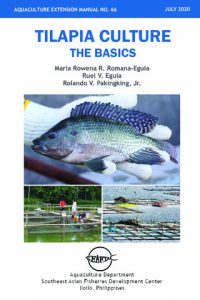 |
AEM 66 Tilapia culture: The basics |
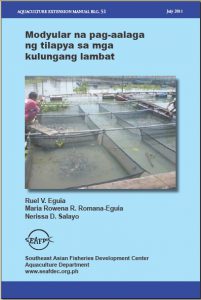 |
AEM 51 Modyular na pag-aalaga ng tilapya sa mga kulungang lambat (2011) 27 pp |
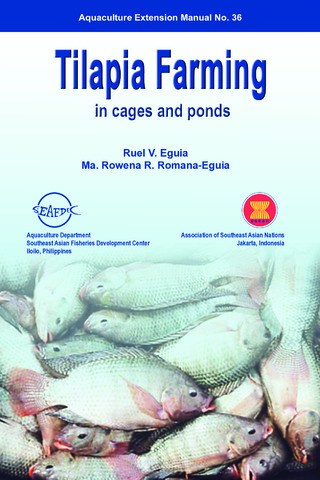 |
Tilapia farming in cages and ponds (2004) 40 pp Eguia, Maria Rowena Romana-Eguia This 40-page manual describes the farming practices for tilapia in cages, pens, ponds, and tanks. Also details selection of quality seedstock, maintenance of stock (feeding, water management), and harvesting. Download here for free |
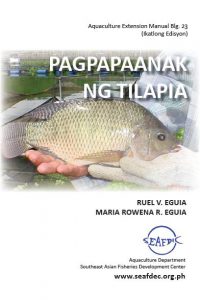 |
AEM 23 Pagpapaanak ng Tilapya, 3rd edition (2007) 52 pp Download here for free |
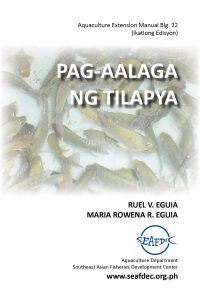 |
AEM 22 Pag-aalaga ng Tilapya, 3rd edition (2007) 55 pp Download here for free |
Check out our online bookstore for more titles: www.seafdec.org.ph/bookstore
Attend our hands-on training!
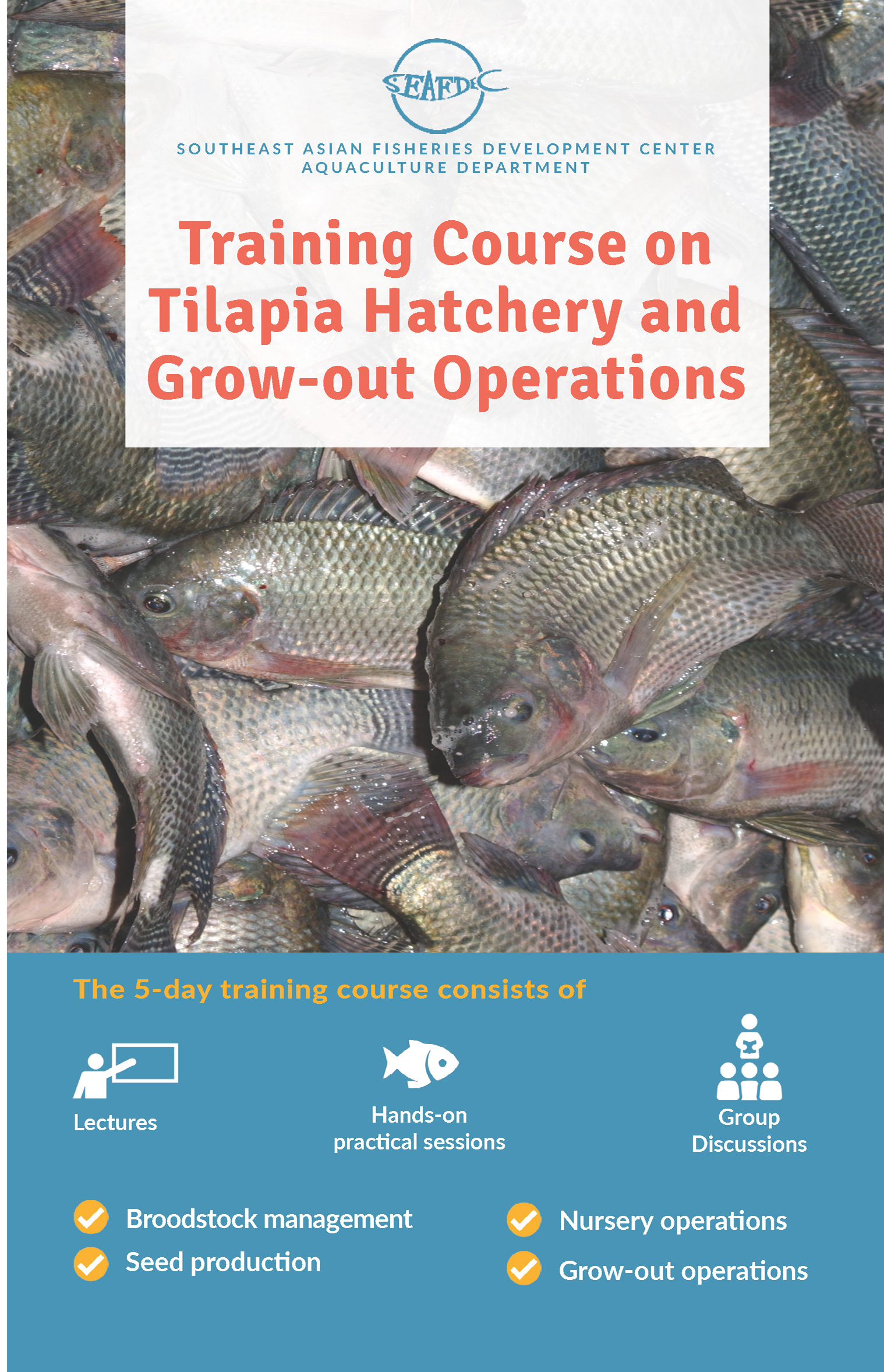
Tilapia Hatchery and Grow-out Operations training course at SEAFDEC/AQD’s Binangonan Freshwater Station.
 |
| View training brochure |
To apply, kindly contact:
Training and Information Division
(63-33) 330 7030
training@seafdec.org.ph
Check out our training schedule: www.seafdec.org.ph/training