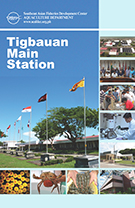
The Tigbauan Main Station (TMS) is the SEAFDEC Aquaculture Department (AQD) headquarters situated right on the beach on the south coast of Panay Island. The 40-hectare complex includes various research laboratories, hatcheries, and broodstock facilities for experiments in artificial propagation, feed development, and health management. TMS also houses the training facilities, library, FishWorld, administration and finance offices, and medical clinic. On-campus housing and cafeteria cater to resident staff, trainees, guests, and visiting researchers and their families.
Research and Development
Research is done on all life stages (broodstock, hatchery nursery, and grow-out) of the species. Likewise, AQD produces juveniles for aquatic resource enhancement. Studies on nutrition and feed development, fish health management, ecology and farming systems, economic viability of cultured commodities, and the promotion of sustainable aquaculture technologies are also being done to ensure comprehensive and holistic development of aquaculture and enhance its role in securing food and livelihoods in fishing communities.
The economically important commodities being studied at AQD include:
- Oyster
- Pompano
- Rabbitfish
- Seabass
- Sea Cucumber
- Seaweeds
- Silver Therapon
- Tiger Shrimp
- Tilapia

Products and Services
Technical Assistance / Consultancy
SEAFDEC/AQD offers technical assistance to stakeholders of the aquaculture industry through its extension and technical consultancy services. (Learn more)
Hatchery Fry / Seedstocks
TMS has hatchery facilities for milkfish, high-value marine fishes, abalone, mangrove crab, shrimp, sea cucumber, and tilapia.
TMS has a total production capacity of 300 tons for larval rearing of marine and freshwater fishes and 4.2 tons for abalone juveniles. AQD demonstrates and continues to assess the viability of its technologies through production runs. (Learn more)
Disease Diagnostics / Analytical Services
SEAFDEC/AQD offers disease diagnostic services for viral, bacterial, and parasitic diseases determined by PCR. Also available are electron microscopy imaging (SEM), chemical and microbiological analyses of: (1) feeds, feed ingredients, experimental animals; (2) water; (3) soil; (4) food products and water. (Learn more: Analytical Services and Diagnostics Services)
Live Feed available for sale
The larval Food Laboratory (LFL) of SEAFDEC/AQD cultures several species of microalgae that provide food for aquatic organisms. (Learn more)
Feed Mill Services
SEAFDEC/AQD Feed Mill can produce 300 kg of feed per hour for its verification and extension studies. AQD aims to develop low-cost and high-quality feeds ,including formulated diets for grow-out and broodstock. Studies on alternative feed ingredients are being conducted, including the use of agricultural by-products and wastes, leaf meals, and distillery wastes. (Learn more)
Training Courses
To develop and strengthen the capacities of the aquaculture sector, science-based aquaculture technologies generated through years of research and verification process are translated into training packages to facilitate adoption by stakeholders. (Learn more)
Bookstore
AQD publishes aquaculture materials which are descriptive of its science-based technologies. Manuals, monographs, among others, are available for sale at the AQD Bookstore. (Learn more)
Library
AQD Library has one of the best collections of books, journals, and other materials on aquaculture in Southeast Asia. The library is open Mondays to Fridays, from 8 am to 5 pm. Internet access is provided for free to students and AQD trainees.
Fishworld
FishWorld is a museum-aquarium-visitor center that promotes informal education for responsible aquaculture in particular, biodiversity, environmental protection ,and sustainable development in general. (Learn more)

Tigbauan Main Station Brochure (2018)
Download
SEAFDEC/AQD Southeast Asian Fisheries Development Center | Aquaculture Department