Saturday , 10 October 2026

Search Results for: Government of Japan Trust Fund

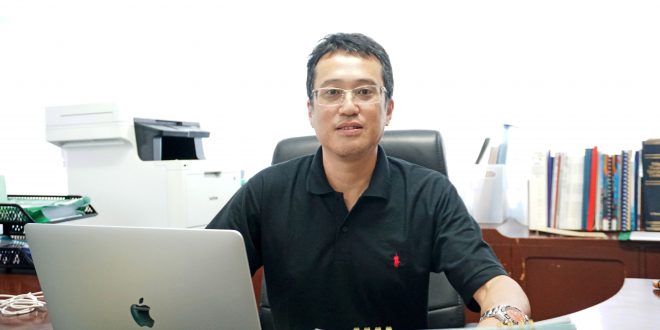
Japanese conservation biologist is new deputy chief of SEAFDEC/AQD

  The Southeast Asian Fisheries Development Center (SEAFDEC), a regional treaty organization that promotes sustainable fisheries among its 11 member countries, welcomed the new deputy chief of its Aquaculture Department (AQD) based in Iloilo last Oct. 20, 2020. Dr. Sayaka Ito, a Japanese scientist with expertise in aquatic conservation biology, replaced fellow Japanese Dr. Koh-ichiro Mori who served as the Deputy Chief from April 2018 to June 2020 in this organization that is mandated to conduct scientific research to generate aquaculture technologies, develop skilled manpower for the aquaculture sector, and disseminate aquaculture information. Upon endorsement by the Government of Japan, SEAFDEC Secretary-General Malinee Smithrithee appointed Dr. Ito to a 2-year term from Oct. 1, 2020 to Sept. 30, 2022 wherein …

Read More »

Reviewers react positively to GOJ-TF studies

“In behalf of the Government of Japan, I would like to express my sincere respect to all the activities conducted by AQD researchers,” said Mr. Tetsuya Murakami during the Annual progress meeting of the program under the ASEAN-SEAFDEC Consultative group mechanism funded by the Government of Japan Trust Fund (GOJ-TF) in SEAFDEC/AQDheld 12-13 February.

Read More »

International seminar on stock enhancement

SEAFDEC/AQD and the Government of Japan Trust Fund (GOJ-TF) conducted the “International seminar on environment - friendly aquaculture and stock enhancement in Southeast Asia” on 3 December at AQD’s main station in Tigbauan, Iloilo, Philippines.

Read More »

GOJ-TF projects reviewed

AQD’s projects under the Government of Japan Trust Fund (GOJ-TF) were evaluated during the Annual progress meeting held 8-9 February in Tigbauan, Iloilo.

Read More »

AQD and GOJ-TF convene two international events

On 1 December 2001, SEAFDEC/AQD and the Government of Japan Trust Fund (GOJ-TF) hosted the International seminar on environment-friendly aquaculture & stock enhancement in Southeast Asia and concluded the International training course on community-based freshwater aquaculture for remote rural areas of Southeast Asia.

Read More »

AQD holds on-site training in Myanmar and Lao PDR

SEAFDEC/AQD organized two on-site training on mud crab culture and fish health management in Myanmar and Lao PDR, respectively. The mud crab training was held from 26 September to 1 October; while fish health training was conducted from 11-14 October. Both training were funded by the Government of Japan Trust Fund.

Read More »

Directory of Experts – Ma. Junemie Hazel Lebata-Ramos

Ma. Junemie Hazel Lebata-Ramos PhD (Ocean Sciences) Expertise: Mollusks (abalone, oysters, etc.), mangroves Email: jlebata@seafdec.org.ph Ma. Junemie Hazel L. Lebata-Ramos joined the Southeast Asian Fisheries Development Center Aquaculture Department (SEAFDEC/AQD) in 1993 as Technical Assistant I and rose to the ranks until she became a Senior Scientist in 2024. She was designated as Head of the Department’s Research Division from August 2013 to April 2015 and Head of the Training and Information Division from April 2015 to September 2017. Her past and present research works include studies on the biology, ecology, assessment, and rehabilitation of mangroves; biology, ecology, assessment, stock enhancement and culture of mollusks (abalone, oyster, giant clam, angelwing clam, and toothless lucine) and crustaceans (Scylla spp. and penaeid …

Read More »

Agri-wastes eyed as cheap, eco-friendly source of fish feed

AFFORDABLE and sustainable feed ingredients for fish farmers are in the works as researchers continue to develop fish diet formulations using discarded agricultural wastes and byproducts. Dr. Frolan Aya, a scientist at the Southeast Asian Fisheries Development Center Aquaculture Department (SEAFDEC/AQD), and his colleagues examined agricultural wastes and byproducts for potential inclusion in diets formulated for omnivorous fish such as Nile tilapia (Oreochromis niloticus) in their study, “Potential use of agricultural wastes in aquafeed production.” Fruit peels, pulps or brans, seeds, bagasse (sugarcane residue), molasses, and okara (soybean curd residue) comprise 40 to 60 percent of wastes generated from major crop industries such as coconut, banana, pineapple, mango, citrus, and sugarcane. While these agri-wastes have found some use as organic …

Read More »
Translate »