 SEAFDEC/AQD Southeast Asian Fisheries Development Center | Aquaculture Department
Why GROUPER?
Groupers (Epinephelus spp.), locally known as lapu-lapu or inid, are high-value species with great potential in aquaculture. They are valued for their excellent texture and flavor. The demand for grouper in the local and international market is fast-growing particularly in Hongkong, Japan, Taiwan, Korea, and Singapore. Fry is also potentially available any time of the year since broodstock spawn all year round.
How to culture GROUPER?
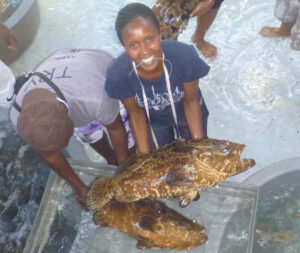
Grouper culture has three phases (1) the hatchery rearing where larvae are reared from hatching until 60 days, (2) the nursery rearing where fish is
cultured for 1-2 months, and (3) the grow-out stage where fish is reared for 6-8 months. Grouper should be sorted and size graded during the late hatchery and nursery stage to prevent cannibalism. Other routine procedures include feeding, net maintenance, stock sampling, and monitoring water quality. Groupers can reach the market size of 300-350 grams in 5-7 months when 2.5-3 inches fry are stocked.
Hatchery phase
-
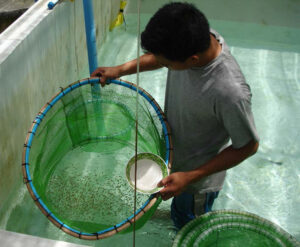
Collecting of grouper fry in rearing tanks Stock 20-30 larvae/liter in 3-25 tons rearing tanks. Grouper larvae are available at SEAFDEC/AQD’s marine fish hatchery
- Feed larvae with Nannochlorum, rotifer, Artemia, and artificial diet
- Transfer larvae to marine cages or to brackishwater ponds when larvae reach the length of 2-3 cm for nursery rearing
Nursery phase
-
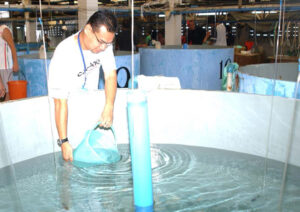
SEAFDEC/AQD’s multi-species marine fish hatchery Stock 2-3 cm fry in 1 x 2 x 1.5 m hapa nets at 75-100 fry/m3 set inside the floating net cages. Uniform fry size should be strictly observed during stocking
- Install hover-type lamp to attract grouper prey such as copepods, mysids, young fishes, and crustacean larvae
- Feed fry with artificial diet or finely chopped frozen or fresh low-value fish 4-6 times a day
- Transfer fry to grow-out cages or ponds after 45-60 days or when
total length is 6-10 cm
Grow-out phase
-
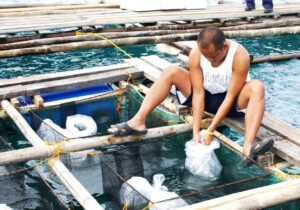
Acclimatizing grouper juveniles in floating net cages Stock 6-10 cm juveniles in ponds at 5,000-10,000 juveniles/hectare or floating net cages at 15-20 juveniles/m3
- Feed juveniles with fresh or frozen chopped fish daily at 10% of average body weight (ABW) or artificial diet at 3% ABW, with half of the ration given early in the morning and the other half late in the afternoon
-
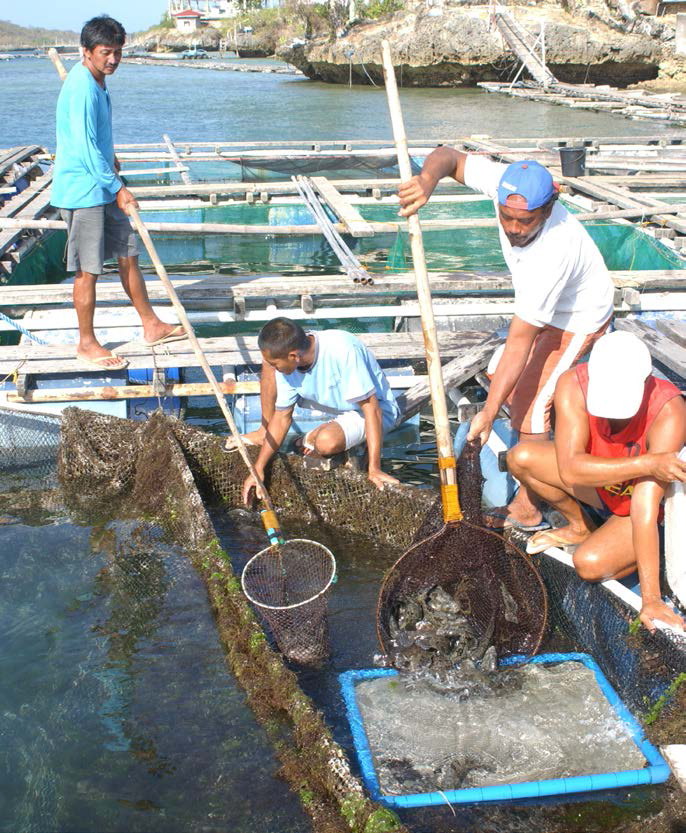
Grouper harvest in floating net cages When fish are about 200 grams, reduce feeding frequency to once daily with fresh or frozen chopped fish at 5% ABW or artificial diet at 2% ABW. The feed should be given in small quantities, enough for fish to swallow when they come up during feeding
- Regularly check and immediately repair damaged nets
- Harvest fish after 5-7 months or when fish reach the market size of 300-350 grams
Site selection for:
Sea cages
- Minimal pollution
- Protected from adverse weather conditions
- Accessible but secure from poachers
- At least 3 m deep at lowest low tide and away from seagrasses & coral beds
Brackishwater ponds
- Sufficient source of seawater or brackishwater
- 18-32 ppt water salinity
- 27-30°C water temperature
- Dissolved oxygen of the water should be 4-8 ppm
- Soil substrate should be clay, clay-loam, or sandy-clay
- Minimal pollution
- Accessible but free from poachers
Is GROUPER AQUACULTURE profitable?
Live grouper sold in the market fetch a higher price compared to other fishes grown in Southeast Asia. The demand is year-round, and the live fish trade is expanding. However, the local supply has been very limited due to overfishing, destruction of habitats, and higher price offered in the international market.
In the Philippines, the current local market price for live grouper is ₱350 per kilogram or higher.
Technical assumptions*
| Size of net cage | 5 x 5 x 3 m |
| Total number of net cages per module | 6 units |
| Stocking rate per net cage | 15-20 juveniles/m3 |
| Size of initial stock | 2.5-3 in |
| Total number of stocks in 1 module | 9,000 pcs |
| Culture period | 5-7 months |
| Survival rate | 85-90 % |
| Average body weight at harvest | 300-350 g |
| Croppings per year | 1.5 |
| Total harvest | 720 kg-840 kg |
| Farm gate selling price | PhP 350.00 |
| Feed conversion ratio | 5:1 |
Costs-and-returns (as of 2016)
| Revenue (PhP) | 302,400 |
| Total variable cost (PhP) | 153,066 |
| Total fixed cost (PhP) | 38,104 |
| Return on investment (%) | 59 |
* Grow-out culture in floating net cages
Reference:
SEAFDEC Aquaculture Department. (2016). Grouper hatchery and grow-out [Brochure]. Tigbauan, Iloilo, Philippines: Author.
Need ASSISTANCE?
Get a copy of our publications!
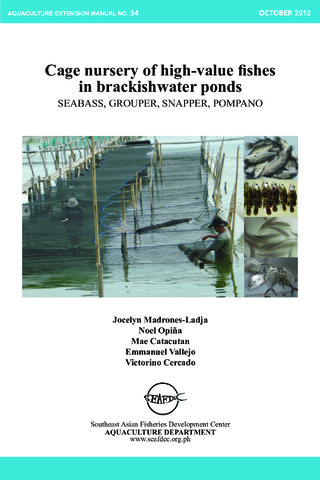 |
AEM 54 Cage nursery of high-value fishes in brackishwater ponds (sea bass, grouper, snapper, pompano) (2012) Jocelyn Madrones-Ladja et al This extension manual describes nursery pond requirements, nursery rearing procedures, common diseases of young marine fish, and economic analysis of cage nursery as an enterprise separate from hatchery and grow-out culture. Each copy costs US$5 |
 |
Grouper Hatchery and Grow-out (2016) The brochure contains information on the hatchery and grow-out culture of grouper.  Download PDF Format — File Size: 1.44 MB Download PDF Format — File Size: 1.44 MB |
Check out our online bookstore for more titles: www.seafdec.org.ph/bookstore
Attend our hands-on training!
Marine Fish Hatchery Operations and Cage/Pond Culture of Selected Marine Species training courses at SEAFDEC/AQD’s Tigbauan Main Station.
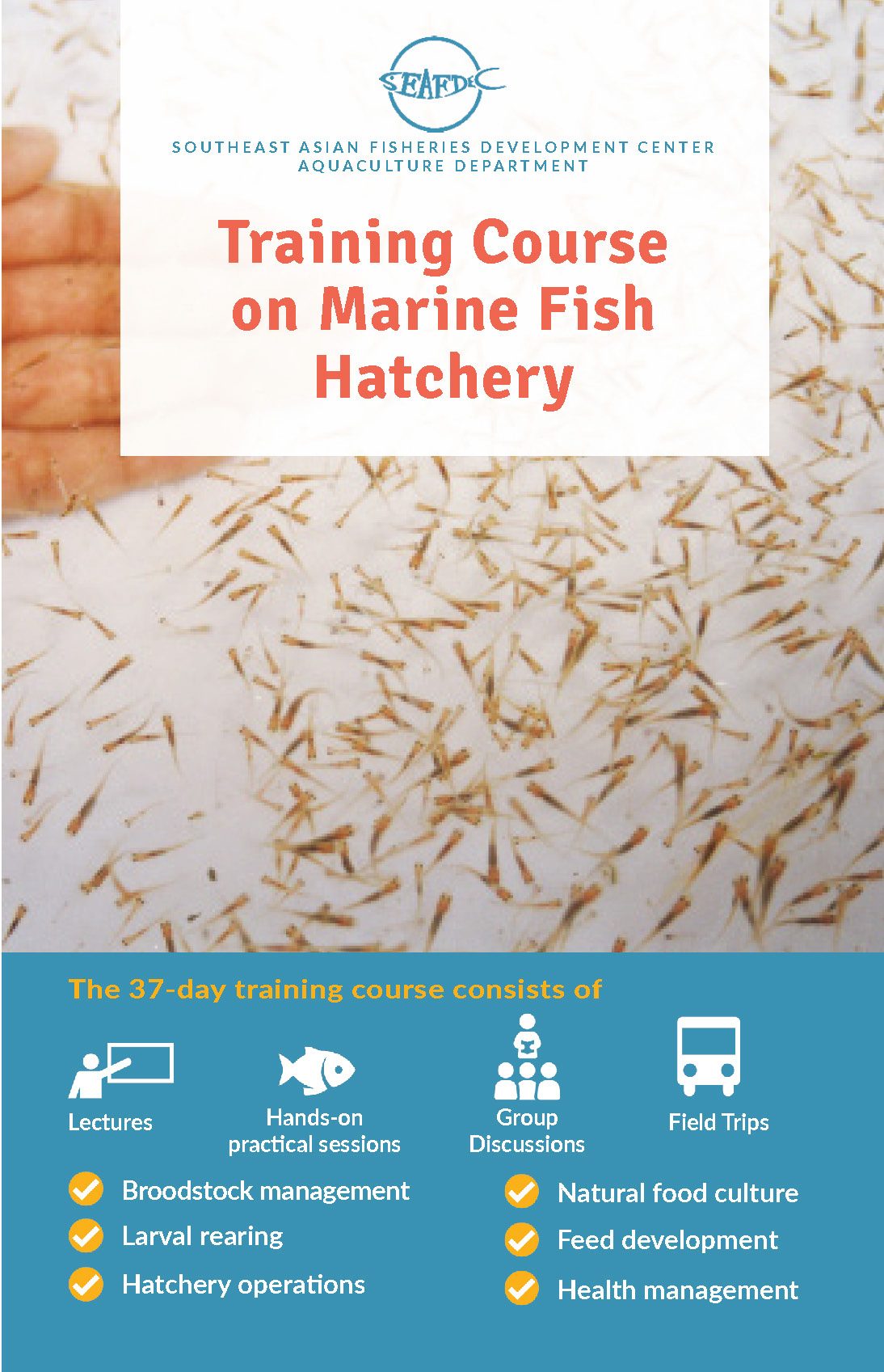 |
| View training brochure |
To apply, kindly contact:
Training and Information Division
(63-33) 330 7030
training@seafdec.org.ph
Check out our training schedule: www.seafdec.org.ph/training